How to Film Your Badminton Match on a Phone (So the Analysis Actually Works)
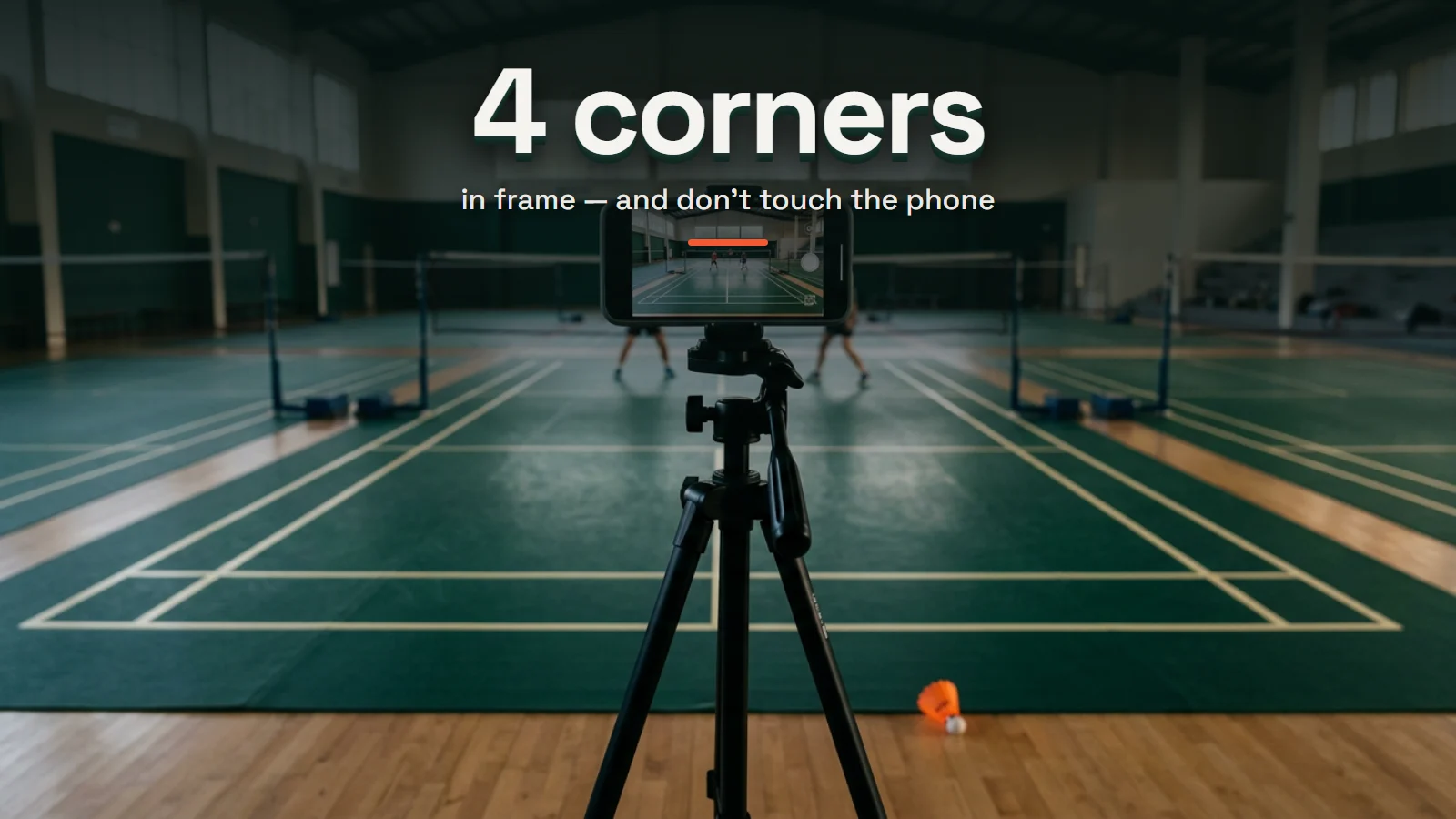
Put the phone behind one baseline, as high as you can safely place it, in landscape, with all four corners of the court visible — and then do not touch it. That single setup is the difference between footage that can be analysed and footage that cannot.
The instinct when filming sport is to follow the action. For analysis, that instinct is the enemy. Any system that measures movement and court position has to work out where the court is first — and it does that from the court lines, which means the lines have to stay put.
The two rules that matter
1. All four court corners in frame, the whole time
Court position is calculated from the four corners of the court. If a corner is cut off, or a player walks in front of it, or the frame drifts, there is no reliable reference for anything — no court coverage, no movement scoring, no positional data.
2. The camera does not move
Prop it, lean it, tape it, borrow a tripod, sit it on a bag on a bench. Do not hold it, and do not pan to follow the shuttle. A fixed frame is worth more than a better camera.
Where to put the phone
Behind one baseline, centred on the court, and elevated — up a few rows of seating, on a stack of chairs, on a bag on a bench. Height matters more than most people expect: from too low, the far players and the far baseline get hidden behind the near ones.
Get it right and the court appears as a trapezoid in frame — the near baseline looking wider than the far one, and the far baseline sitting higher up the image. That shape is what makes the geometry solvable. If your near and far baselines look about the same width, the camera is too low.
The specs
Setting
What to use
Why
Orientation
Landscape
A badminton court is long and wide. Portrait crops off the corners you need.
Position
Behind the baseline, centred, elevated
The only angle that keeps all four corners visible and separable.
Camera
Locked off — tripod, ledge, or propped on a bag
A moving frame breaks the court reference.
Clip length
Up to 120 seconds
That is the maximum Kreeda accepts. Longer files can be trimmed to a 120-second window during upload.
File size
Up to 500 MB
The upload limit. 1080p at 30 fps for two minutes sits comfortably inside it.
Format
MP4, MOV or AVI
The three formats accepted. iPhone MOV and Android MP4 both work as-is.
Zoom
None
Digital zoom costs detail and tempts you into reframing mid-rally.
The five mistakes that ruin footage
Filming in portrait. The most common mistake and the least recoverable — the corners simply are not in the frame.
Following the shuttle. Feels natural, destroys the court reference. Frame the court once and leave it.
Filming from the side at net height. Players overlap constantly and the court is edge-on, so depth is unreadable.
Standing too low behind the baseline. The near player hides the far half of the court.
Shooting into the light. Backlight from a window or a bright doorway silhouettes players against the floor and loses both bodies and lines.
A locked-off phone on a chair beats a hand-held flagship every time. Stability is the feature.
Sixty-second checklist
Landscape, behind the baseline, centred, as high as is safe.
All four court corners visible — check the preview before you press record.
Phone propped so it cannot slip. Nothing will be in front of it.
Not pointing into a window or bright doorway.
Record continuous play, not warm-up. Two minutes of real rallies is plenty.
One last thing worth saying: two minutes of continuous rallies is genuinely better than ten minutes of a match with long gaps between points. Pick a passage where the badminton is happening.
Common questions
How long can my badminton video be?
Up to 120 seconds. If your recording is longer, you can pick which 120-second window to use during upload rather than re-editing the file yourself.
What video formats and sizes are accepted?
MP4, MOV and AVI, up to 500 MB. Both iPhone (MOV) and Android (MP4) recordings work without conversion.
Does it have to be landscape?
Yes, in practice. A badminton court is far wider than it is tall in frame, and portrait almost always cuts off the court corners the analysis depends on.
Can I film from the side of the court?
It is much worse than behind the baseline. From the side, players overlap, the court is edge-on, and depth becomes very hard to read. Behind the baseline and elevated is the setup to aim for.
Do I need a tripod?
No. Anything that holds the phone still works — propped against a bag, wedged on a ledge, or sat on a chair a few rows up. Stillness is the requirement, not equipment.